The Test That Refused to Stop
The original plan was an eight-hour run. Figure AI's Helix-02-powered robots were tasked with sorting small packages in a warehouse environment: pick up the package, locate the barcode, place it on a conveyor belt with the barcode facing down. Repeat.
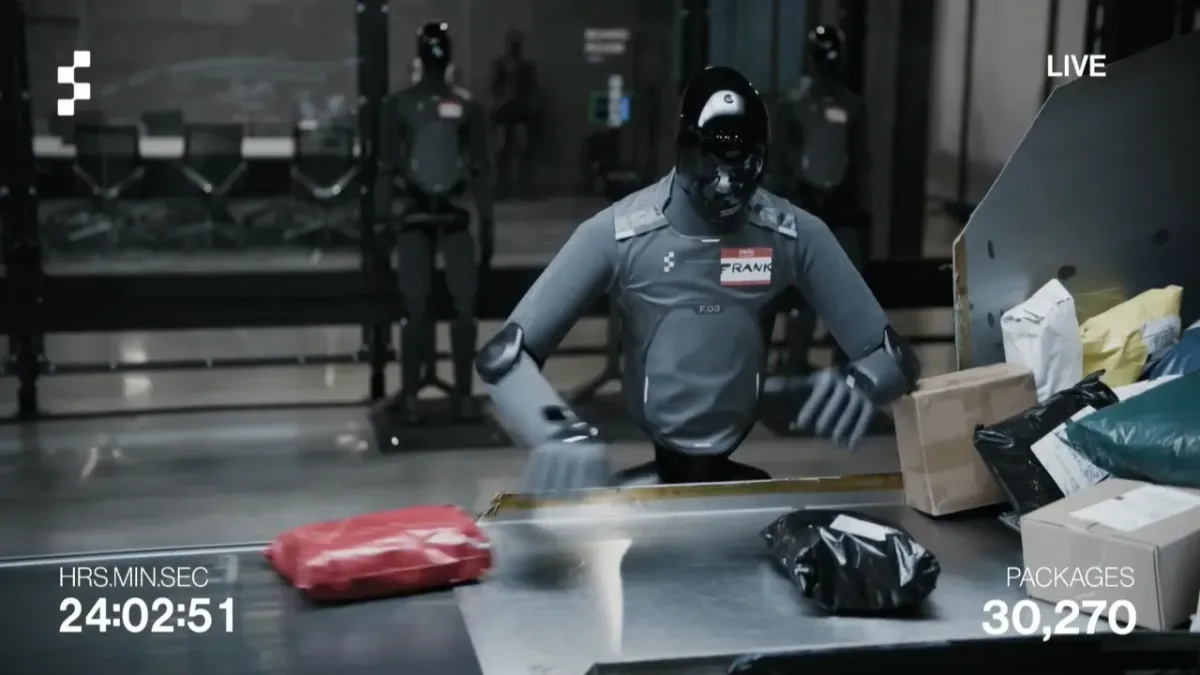
When the robots completed the eight-hour window without a reported failure, the company kept the test running. By the time it ended, the three robots had sorted more than 28,000 packages and logged over 24 hours of continuous autonomous operation. According to CEO Brett Adcock, every action was driven directly by Helix-02, no remote human steering, no intervention.
The task sounds simple on paper. In practice, warehouse sorting requires steady movement, fast decisions, and the ability to keep performing when small problems arise. Figure AI says its robots operated at speeds close to human workers throughout the run.
What Is Helix-02?
Helix-02 is Figure AI's in-house AI system, described by the company as a neural network that integrates vision, touch sensing, body awareness, and movement control into a single system.
Humanoid robots present a different engineering challenge than industrial arms or wheeled bots. They have to balance on two legs, grip objects of varying sizes and weights, adjust posture mid-motion, and respond when something lands in an unexpected position. Helix-02 uses onboard cameras and AI reasoning to detect barcodes and make real-time sorting decisions without external guidance.
The system also includes an automatic reset function. When a robot encounters a situation outside its expected behavior, getting stuck, losing grip, facing an unfamiliar package orientation, Helix-02 can trigger a self-reset and resume work. If a hardware or software issue requires the robot to leave the work floor entirely, another unit can take over, keeping the operation running without interruption.
That recovery capability may sound like a footnote, but in real warehouse environments it is one of the most important factors for adoption. A robot that needs human help every few minutes is a liability. A robot that can pause, reset, and get back to work on its own starts to look like infrastructure.
Bob, Frank, and Gary
The 24-hour run was livestreamed, and viewers watched in real time as the robots kept sorting long after the original deadline passed. Somewhere along the way, people started giving them names. Bob, Frank, and Gary stuck.
Once the nicknames caught on online, Figure AI added visible name tags to the robots. It was a small gesture, but it shifted how people related to what they were watching. The robots started to feel less like machines running a demo and more like the workers pulling the late shift.
That human touch also made the harder question more difficult to set aside: if these robots can run through long shifts without stopping, what does that mean for the people who currently do this work?
The Competition Is Closing In
Figure AI is not operating in an empty field. Tesla, Agility Robotics, and Apptronik are all developing humanoid robots aimed at warehouses, factories, and logistics operations. The race to prove real-world viability in industrial environments is moving fast, and the benchmarks are shifting from "can it do the task" to "can it do the task for hours without stopping."
Figure AI has already tested its robots at BMW manufacturing facilities in South Carolina, giving it a foothold in controlled industrial deployment before broader commercial rollout. That trajectory, proving the technology in structured, high-stakes environments first, is likely the path most of these companies will follow before humanoid robots appear in more varied settings.
Package sorting is a useful proving ground precisely because it is legible. Anyone can understand what the robot is doing, assess whether it is doing it correctly, and follow the logic of why it matters at scale.
What Still Needs to Be Proven
A 24-hour livestreamed test is a meaningful data point. It is not the whole story.
Businesses evaluating this technology will want to know how often the robots fail across thousands of hours of operation, not just one strong run. They will want maintenance cost data, failure rate statistics, and performance results under the conditions that real warehouse floors actually present: packages in irregular shapes, labels in awkward positions, conveyor jams, and people moving through the workspace.
They will also want evidence that is not self-reported. A company running its own public demo controls the conditions. Independent testing in genuinely uncontrolled environments is a different standard and a necessary one before this technology becomes part of real labor infrastructure.
The messiness of real workplaces is exactly where demos tend to break down. Figure AI's test showed endurance. The next tests will need to show adaptability.
What This Means for Workers and Consumers
For most people, humanoid warehouse robots still feel distant. The costs are high, the deployments are limited, and the technology is still in active development. The concerns are real but not yet immediate for the majority of workers.
That said, the direction is clear. Faster, more reliable package handling affects delivery timelines. Warehouses that adopt automation will change how they staff overnight and high-volume shifts. Physically demanding or difficult-to-staff roles are typically the first targets.
The honest picture is more complicated than either "robots will take all the jobs" or "nothing will change." Real workplaces are messy, equipment fails, and human judgment solves problems that structured demos rarely surface. Warehouse workers are not going away because three robots sorted packages for a day.
What Figure AI's test does suggest is that humanoid robots are moving past the proof-of-concept stage and into longer, more serious workplace trials. The gap between a short demo clip and a 24-hour autonomous operation is not trivial. It is the kind of gap that investors, logistics companies, and the workers watching the livestream were all paying attention to.
Bob, Frank, and Gary kept sorting. The questions they raised are going to take longer to answer.